
A wisdom teeth infection can go from mild discomfort to significant swelling and difficulty opening the mouth faster than most people expect. It's one of those problems that's easy to dismiss early on — and harder to ignore once it's progressed.
Here's what's behind it, what the symptoms look like, and what treatment involves.
What Is a Wisdom Teeth Infection?
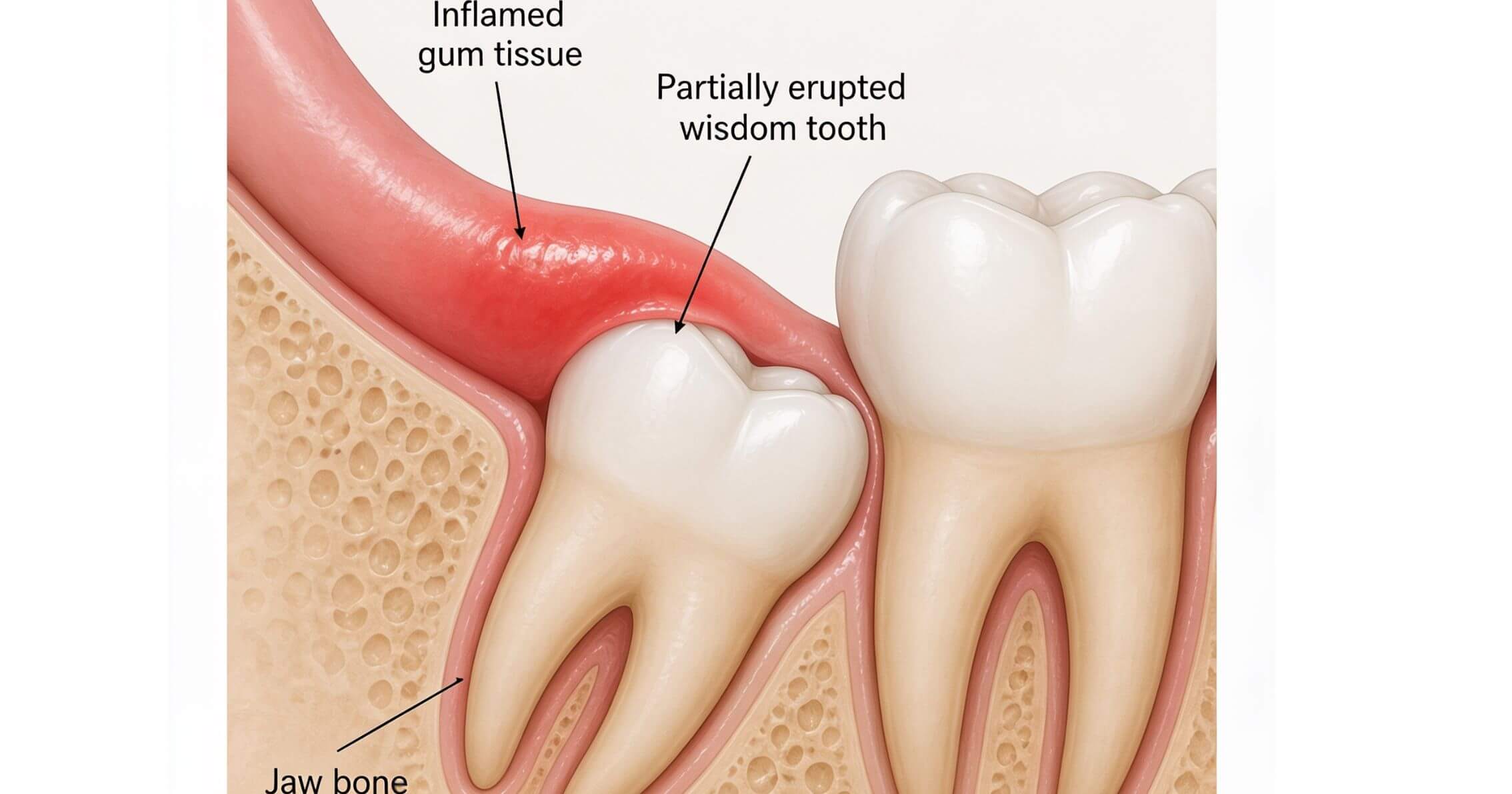
The most common infection affecting wisdom teeth is called pericoronitis. It develops when the gum around a partially erupted wisdom tooth becomes infected. When a wisdom tooth doesn't fully break through the gum, it leaves a flap of tissue over part of the crown.
Food debris and bacteria collect under this flap, where a toothbrush can't reach, and saliva can't flush effectively. The result is bacterial overgrowth and inflammation in the surrounding tissue.
Wisdom teeth are more likely to develop problems because they come through last—usually in your late teens or early twenties—and often don't have enough room to grow properly. A partially erupted tooth can stay in this vulnerable state for months or years, with repeated episodes of infection if the underlying problem isn't addressed.
A wisdom tooth can also develop an abscess — a localised pocket of infection at the root — particularly if decay has reached the pulp. This is a separate but related condition that carries similar urgency.
Symptoms to Watch For
Pericoronitis symptoms range from mild to severe depending on how far the infection has progressed:
- Swollen, red gum flap over or around the wisdom tooth — the most consistent early sign
- Pain when chewing or biting, especially if the upper tooth is rubbing against the swollen gum over the wisdom tooth.
- Bad taste or smell from the area, caused by bacterial activity under the gum tissue
- Difficulty opening the mouth fully — trismus, or jaw muscle spasm, develops as inflammation spreads
- Swelling of the jaw or cheek
- Swollen lymph nodes in the neck
- Fever or feeling generally unwell
The first few symptoms can come and go. Once jaw swelling, fever, or difficulty swallowing develops, the infection has progressed beyond localised pericoronitis and needs urgent assessment.
What Causes Wisdom Teeth Infections?
The anatomy of a partially erupted wisdom tooth creates the conditions for infection almost by default.
The gum flap
When a wisdom tooth partially emerges, the overlying gum tissue forms a pocket — called the operculum — between the tooth and the gum. This pocket is impossible to clean thoroughly with a toothbrush or floss. Food and bacteria accumulate, the bacteria multiply, and inflammation follows.
Limited cleaning access
Even fully erupted wisdom teeth sit at the back of the mouth where brushing is less effective. Partially erupted teeth compound this — part of the crown is hidden under tissue that can't be cleaned from the outside at all.
Trauma from the opposing tooth
The upper wisdom tooth often bites directly onto the inflamed gum flap over the lower wisdom tooth, causing repeated trauma that keeps the tissue irritated and increases the risk of infection.
Reduced immune response
Stress, illness, or general immune compromise can trigger a flare-up even when the tooth has been stable for a period. Many patients report their first or worst episode coinciding with a period of illness or high stress.
Can It Clear Up on Its Own?
Sometimes the acute phase settles without treatment — swelling reduces, pain eases, and the episode passes. This can give the impression that the problem has resolved. It hasn't.
The structural cause — the gum flap, the limited access for cleaning, the partially erupted tooth — remains unchanged. Another episode is likely, often triggered by something as minor as a cold or a period of poor sleep.
Each recurrence can be more severe than the last, and repeated infections increase the risk of abscess formation and spread into the jaw or neck.
Relying on the infection to clear without addressing the underlying cause is a short-term response to a problem that won't go away on its own.
Treatment Options
The right treatment depends on how severe the infection is and whether it's your first infection or one that keeps coming back.
Antibiotics
Where infection has spread beyond the immediate area — swollen lymph nodes, fever, jaw swelling — antibiotics are prescribed to bring the acute phase under control before further treatment. Antibiotics manage the infection but don't address the cause. They're a first step, not a solution.
Irrigation
The area under the gum flap is cleaned and irrigated to remove debris and bacteria. This provides relief and reduces inflammation, but doesn't resolve the underlying issue.
Operculectomy
In some cases, removing the gum flap surgically — a procedure called an operculectomy — is appropriate. This is only viable when the wisdom tooth itself is healthy, properly positioned, and worth keeping.
Wisdom Tooth Removal
For most patients with recurrent pericoronitis, removal of the wisdom tooth is the definitive solution. Once the tooth is gone, the gum flap and the pocket it creates go with it — eliminating the environment where infection develops.
At Prahran Family Dental, Dr Jun manages the full process in-house — from assessment and antibiotics where needed, through to extraction. Patients don't need a referral to an oral surgeon for straightforward and moderately complex cases, which means less waiting and a single point of care through the process.
Frequently Asked Questions
How do I know if my wisdom tooth is infected or just sore?
Soreness alone — particularly after the tooth has been erupting — is common and doesn't necessarily indicate infection. Infection is more likely when there's a bad taste or smell from the area, swelling of the gum or jaw, fever, or difficulty opening the mouth. If you're unsure, a clinical assessment is the only reliable way to tell.
Can I treat a wisdom tooth infection at home?
Home care — saltwater rinses, over-the-counter pain relievers, and keeping the area clean — can temporarily reduce discomfort. It doesn't treat the infection. If symptoms are present, particularly swelling or fever, see a dentist promptly rather than managing them at home and hoping they settle on their own.
Will I need antibiotics?
Not always. For mild, localised pericoronitis without fever or spreading swelling, irrigation and cleaning may be sufficient. Your Prahran dentist may prescribe antibiotics if the infection is spreading or if you're experiencing symptoms such as fever or feeling generally unwell.
Is wisdom tooth removal the only long-term fix?
For most patients with recurrent infections, yes. An impacted or poorly positioned tooth that cannot be cleaned properly is likely to cause recurring problems. An operculectomy is an option in specific circumstances, but removal is the more reliable long-term solution for most cases.
How urgent is a wisdom tooth infection?
A first episode with mild symptoms — localised swelling, mild pain, no fever — can usually be assessed at a scheduled appointment within a day or two. Fever, significant jaw swelling, difficulty swallowing or opening the mouth, or swelling spreading toward the neck requires same-day assessment. If the airway feels compromised, go directly to an emergency department.
Wisdom Tooth Infection Treatment in Prahran
If you're experiencing pain, swelling, a bad taste in your mouth, or other signs of a wisdom tooth infection, don't wait for the problem to worsen. Our experienced team will determine what's causing your symptoms, help relieve your discomfort as quickly as possible, and recommend the best long-term treatment for your oral health.
Your care is led by Dr Jun Kim, who has close to 20 years of clinical experience and has performed more than 6,000 wisdom teeth extractions. Whether your infection can be managed conservatively or requires wisdom tooth removal, you'll receive personalised care and clear guidance every step of the way.
At Prahran Family Dental, we see patients from Prahran, Windsor, South Yarra, Toorak, and Armadale.
Call us on (03) 9533 2288 or book online.
Visit us at Shop 7, 180 Commercial Road, Prahran.